
An Open Letter to President Ferdinand R. Marcos Jr. Before the 2026 State of the Nation Address (SONA)
Mr. President, The Time to Restore Trust Is Now
Every State of the Nation Address (SONA) is an opportunity to look beyond the headlines and define the legacy of an administration.
This year’s SONA comes at a decisive moment. The Philippines has one of Southeast Asia’s fastest-growing economies, a young and competitive workforce, and unprecedented opportunities under the CREATE MORE Act, the Luzon Economic Corridor, and expanding global supply chains. Yet these strengths continue to be overshadowed by one persistent challenge: declining public trust in government institutions.
Investor confidence ultimately rests on the rule of law. Citizens’ confidence rests on fairness. Sustainable economic growth requires both.
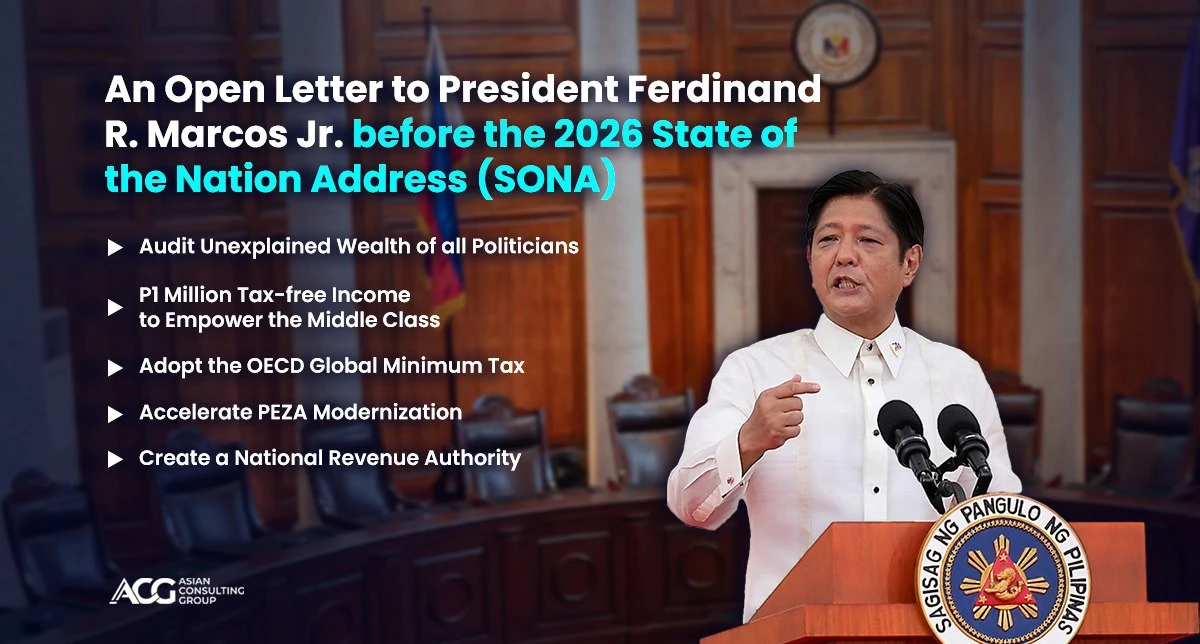
As you prepare to address the nation, I respectfully urge you to prioritize five structural reforms that can restore public trust, strengthen investor confidence, and empower the Filipino middle class.
1. End Impunity by Following the Money
No country defeats corruption by prosecuting only the visible crime. It must also pursue the financial trail.
The Ombudsman has taken an important step by investigating allegations involving public infrastructure spending. The next step is equally critical.
Mandate the Bureau of Internal Revenue to conduct comprehensive audits of unexplained wealth among public officials under investigation. Work with Congress to modernize bank secrecy laws for corruption, tax evasion, and money laundering investigations under strict judicial safeguards. Establish an inter-agency task force composed of the BIR, Ombudsman, Anti-Money Laundering Council, Commission on Audit, Securities and Exchange Commission, Bangko Sentral ng Pilipinas, and other relevant agencies to build stronger financial cases, including tax evasion where warranted.
History offers a powerful lesson. Al Capone was not ultimately imprisoned for his most notorious crimes but for tax evasion. Following the money remains one of the world’s most effective anti-corruption strategies.
No amount of digitalization will restore public trust unless every peso of unexplained wealth is subject to scrutiny—without fear or favor.
2. Empower the Middle Class Through Meaningful Tax Relief
Economic growth becomes meaningful only when ordinary Filipinos feel it in their paychecks.
The GINHAWA Bill deserves to become one of your administration’s priority measures.
Increasing the personal income tax exemption from ₱250,000 to ₱1 million, exempting legitimate overtime pay, and increasing tax-exempt bonuses would immediately increase disposable income for millions of working Filipinos.
Today, the overwhelming majority of personal income taxes are collected from compensation earners. They pay first, every payday, while many with greater economic capacity contribute proportionately less.
A stronger middle class means stronger consumer spending, higher productivity, greater entrepreneurship, and a more resilient economy.
3. Adopt the OECD Global Minimum Tax
The Philippines should immediately adopt and implement the OECD Global Minimum Tax. This reform allows the country to collect revenues from large multinational enterprises that would otherwise be collected by foreign governments.
Instead of increasing taxes on ordinary Filipinos, the Global Minimum Tax enables the Philippines to protect its tax base while remaining globally competitive.
The Department of Finance has estimated that delayed implementation has already resulted in significant foregone revenues. These resources can finance education, healthcare, infrastructure, digital transformation, and climate resilience—without imposing additional burdens on Filipino families.
4. Accelerate PEZA Modernization
Global investors seek certainty, speed, and predictability.
The Philippine Economic Zone Authority has long been one of the country’s strongest investment institutions. Modernizing PEZA through digital permitting, faster approvals, AI-enabled investor services, and streamlined regulatory processes will help position the Philippines as Southeast Asia’s preferred destination for advanced manufacturing, technology, renewable energy, logistics, and shared services.
Investment promotion today is no longer about incentives alone. It is about execution.
5. Create a National Revenue Authority
The Philippines deserves a world-class revenue administration.
A fiscally and politically independent National Revenue Authority integrating the modernization of the Bureau of Internal Revenue and the Bureau of Customs can transform tax administration through artificial intelligence, integrated databases, risk-based compliance, digital services, and institutional independence.
The objective is simple: make tax administration easier for honest taxpayers and far more difficult for tax evaders.
Modern institutions create modern economies.
A Defining Legacy
Mr. President, nations are remembered not only for the infrastructure they build but for the institutions they strengthen.
These five reforms share one common objective: restore confidence.
Confidence that taxes are collected fairly.
Confidence that corruption has consequences.
Confidence that the government serves the people.
Confidence that the Philippines is ready to compete with the world’s best.
History will not simply remember how fast our economy grew.
It will remember whether we built institutions worthy of the trust of every Filipino.
Respectfully,
Mon Abrea, CPA, MBA, MPA (Harvard)
Global Tax Policy Expert
Chief Tax Advisor, Asian Consulting Group (ACGlobal)

Asian Consulting Group
Ready to Take the Next Step?
uniting global leaders, investors, and policymakers.