
High-Level DOF Dialogue Signals Strong Momentum for Tax Reform and Investment Competitiveness

Manila, Philippines — March 27, 2026 — A high-level policy dialogue between the Department of Finance (DOF) and the Asian Consulting Group (ACG) highlighted the Philippines' accelerating push toward practical, enforceable, and globally aligned tax reforms aimed at strengthening revenue generation and boosting investor confidence.
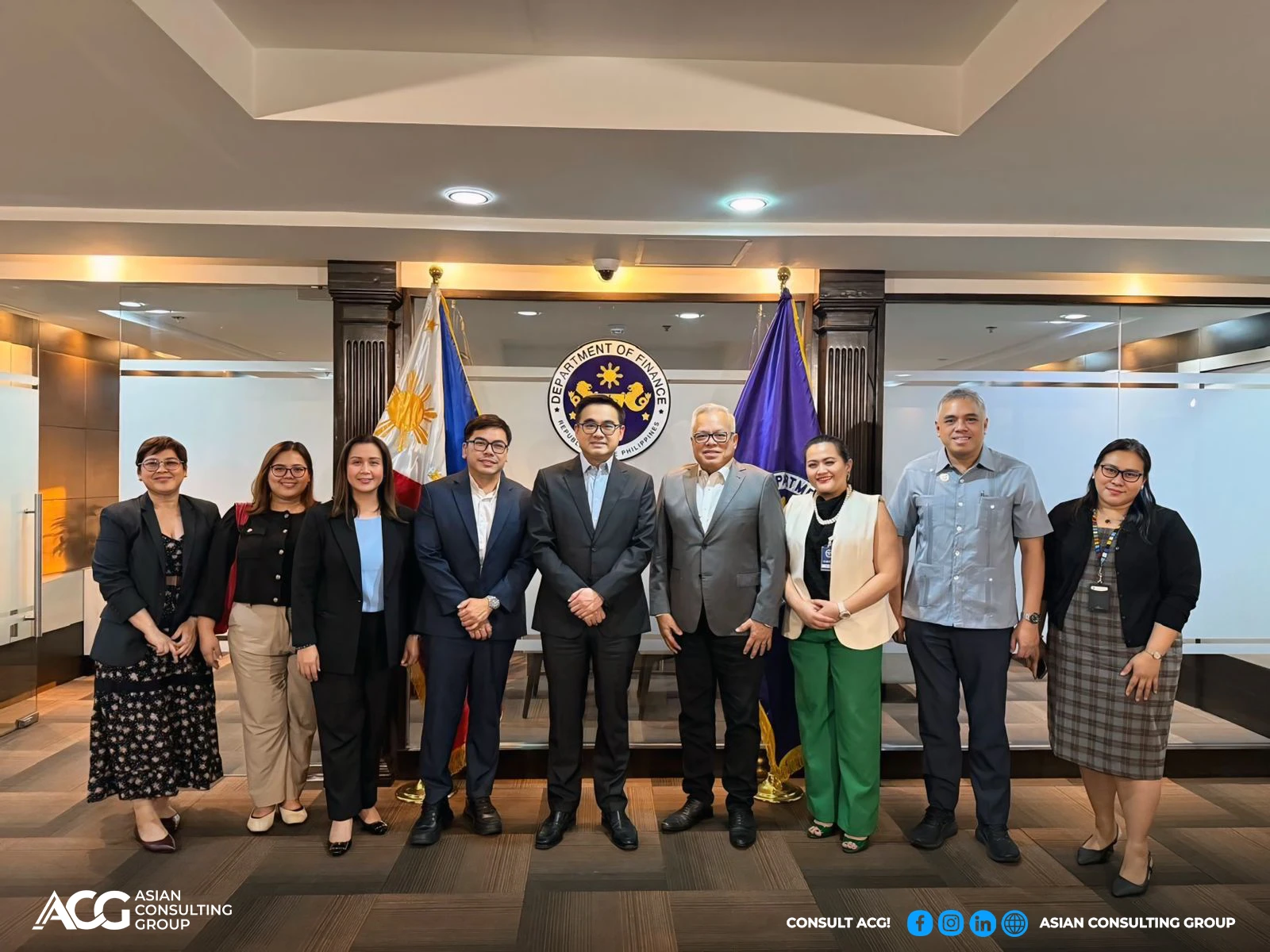
Finance Secretary Frederick Go led the meeting, joined by senior officials from the DOF, including Undersecretary Angela Ignacio of the Government Corporations & Investment Group (GCIC); Undersecretary Rolando Ligon Jr., of the Revenue Operations Group (ROG); Director Maria Genelin Licos of GCIC; and Assistant Secretary Euvimil Nina Asuncion of ROG.
Representing ACG was global tax policy expert and Chief Tax Advisor Mon Abrea, together with ACG directors and senior leaders, including former Trade Secretary Ramon Lopez, Chief Strategy Officer Hazel Joy Mendoza, and Atty. Eirene Aguila joined the high-level discussion in advancing reforms that deliver real, measurable results for Filipinos.
Following the formal dialogue, the engagement continued over a working dinner joined by former IPOPHL Director General Rowel Barba, further reinforcing public-private collaboration in shaping forward-looking economic and tax policies.
Faster VAT Refunds: Reform Delivering Real Results
One of the most compelling outcomes highlighted during the dialogue was the significant improvement in VAT refund processing following reforms under CREATE MORE.
Drawing from ACG’s engagement with foreign investors, Abrea shared that a recent VAT refund application for a UK-based firm was processed in less than 60 days, with no friction or delays. This milestone reflects the effectiveness of the government’s risk-based approach and the establishment of a dedicated VAT Refund Center.
"This is proof that reform is not theoretical—it is working,” Abrea said. “When systems are clear, rules are enforced, and processes are modernized, investor confidence follows."
OECD Global Minimum Tax: A Critical Revenue Priority
A defining moment in the meeting was Secretary Go’s confirmation that the DOF will prioritize the enactment of the OECD Global Minimum Tax (GMT)—a reform seen as critical to protecting the country’s tax base in an increasingly globalized economy.
The measure is projected to generate up to ₱100 billion in additional revenues from large multinational corporations within its first two years of implementation.
Abrea emphasized that delays in adopting the GMT have already cost the Philippines tens of billions of pesos in foregone revenues, as other jurisdictions moved swiftly to implement the global framework.
"We need reforms that work now,” Abrea stressed. “Every year of delay is revenue lost—revenue that could have funded infrastructure, education, and social protection."
Addressing Cross-Border Taxation and IT-BPM Industry Concerns
The dialogue also tackled pressing issues raised by the IT-BPM sector, particularly on cross-border taxation.
This follows the issuance of Revenue Memorandum Circular (RMC) No. 24-2026, which clarifies the application of RMC Nos. 5-2024 and 38-2024 on the tax treatment of cross-border services. While this development is a step in the right direction, both DOF and ACG acknowledged that further clarity and legislative action are needed to fully resolve longstanding ambiguities.
Following recent engagements with industry stakeholders, including IBPAP, ACG raised concerns over the classification of IT-BPM firms as "high-risk taxpayers" under audit priority programs of the Bureau of Internal Revenue—particularly for firms legitimately availing of incentives.
“Policy must be aligned with investment promotion,” Abrea noted. “We cannot penalize the very industries driving exports, jobs, and digital transformation.”
Both sides expressed openness to pursuing a separate legislative framework to provide certainty, consistency, and global alignment in cross-border taxation.
Toward a Modern Revenue System and Investment Ecosystem
Beyond immediate reforms, both DOF and ACG underscored the urgency of structural transformation to future-proof the country’s tax system.
Key priorities discussed include the adoption of the OECD Global Minimum Tax, strengthening cross-border tax rules, VAT rationalization, and simplifying the Ease of Paying Taxes (EOPT) framework. Equally important is the full modernization of the Bureau of Internal Revenue and Bureau of Customs through digitalization and data-driven systems.
Abrea also highlighted the need to establish a National Revenue Authority, which would grant fiscal and political autonomy to revenue agencies—ensuring efficiency, transparency, and accountability.
At the same time, he reiterated strong support for strengthening the Philippine Economic Zone Authority (PEZA) as the gold standard for investor service excellence, citing consistent validation from foreign investors and locators. He emphasized that amending the PEZA law will be critical to maintaining the country’s competitiveness in attracting global investments.
A Shared Commitment to Results-Driven Reform
The high-level dialogue reflects a deepening collaboration between the public and private sectors, anchored on a shared goal: reforms that are not only policy-sound but immediately impactful.
For ACG and its leadership, the engagement with DOF is part of a broader mission to position the Philippines as a premier investment destination through credible, globally aligned tax policy.
“The bottom line is clear,” Abrea concluded. “We need reforms that deliver results now—unlock revenues, restore investor confidence, and secure the Philippines’ place in the global economy.”
About Asian Consulting Group (ACG):
The Asian Consulting Group (ACG) is a leading tax advisory firm in the Philippines, providing strategic tax, investment, and policy advisory services to top corporations, foreign investors, and multinational companies. ACG actively collaborates with government and global institutions to advance meaningful tax reforms and improve the country's investment climate.

Asian Consulting Group
Ready to Take the Next Step?
uniting global leaders, investors, and policymakers.