
Beyond Oil Price Shocks: Why the Philippines Needs a Sustainability and Energy Security Roadmap
By Mon Abrea, CPA, MBA, MPA
Global Tax Policy Expert and Chief Tax Advisor, Asian Consulting Group (ACG)
The recent surge in global oil prices is more than a temporary economic disturbance. It is a warning signal for countries like the Philippines that remain highly exposed to external shocks — from geopolitical conflicts to climate disasters. For policymakers, the current crisis presents an opportunity not only to provide short-term relief but also to rethink the country's long-term strategy for energy security, economic resilience, and sustainable development.
Two global benchmarks illustrate the scale of the current disruption. Brent Crude Oil, the widely cited global benchmark, has recently hovered around $103–$106 per barrel. Meanwhile, Dubai Crude Oil — the benchmark more relevant to Asian markets — has surged to about $120–$128 per barrel. For the Philippines, Dubai crude is particularly significant because most of our oil imports originate from the Middle East.
The price spike is largely driven by geopolitical risks surrounding the Strait of Hormuz, the narrow waterway between Iran and Oman near the United Arab Emirates. Nearly 20 percent of the world's oil supply — around 17 to 20 million barrels per day — passes through this chokepoint. Major exporters such as Saudi Arabia, Iraq, Kuwait, Qatar, and the United Arab Emirates rely on this route. Even the threat of disruption can send global energy prices soaring.
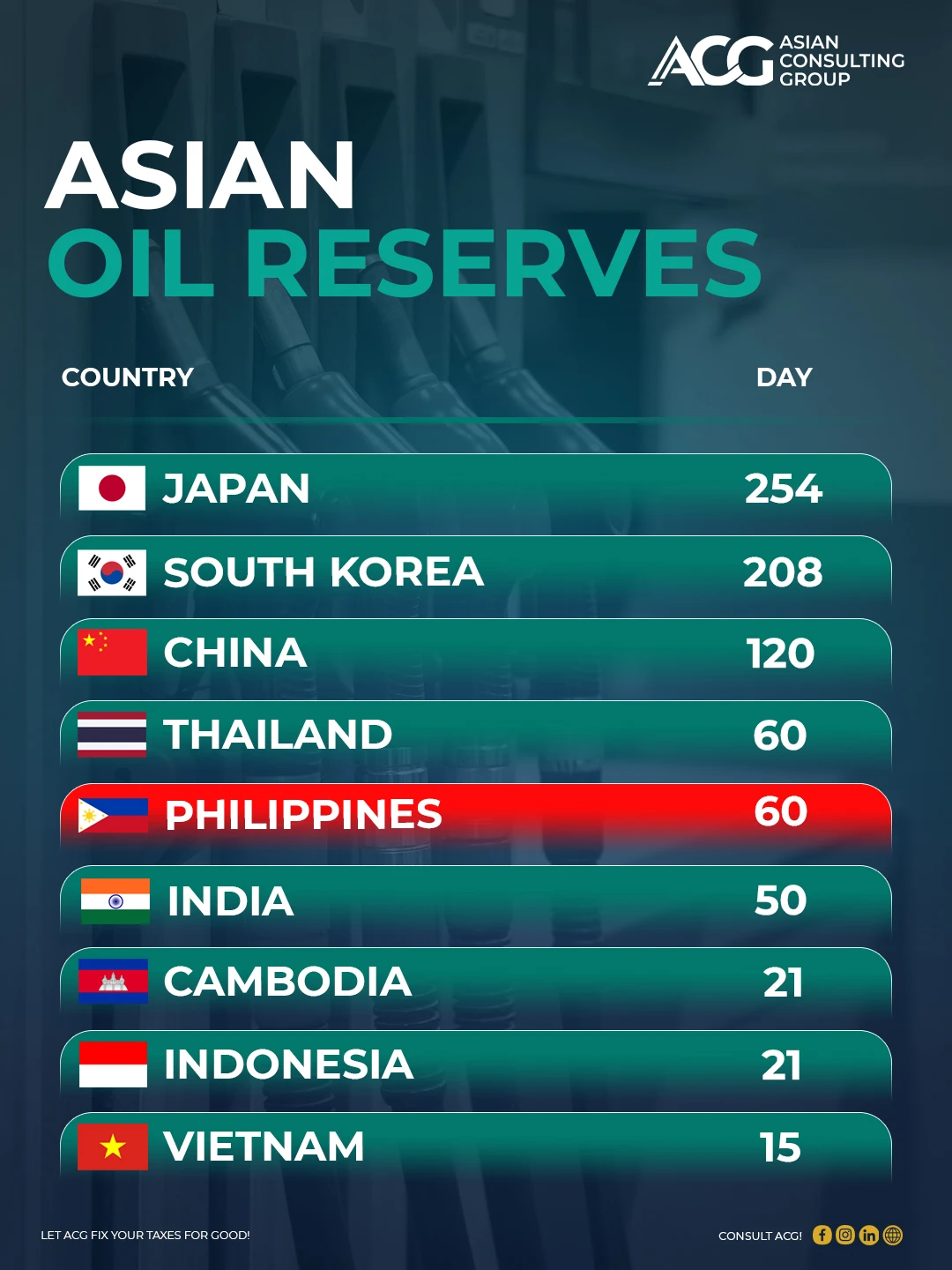
For the Philippines, the vulnerability is clear. The country imports nearly 100 percent of its crude oil requirements, with approximately 90 to 98 percent sourced from the Middle East. Domestic inventories typically cover only 15 to 45 days of supply. While there is no immediate shortage of fuel today, the economy remains highly sensitive to global oil price volatility.
In response, policymakers often turn to suspending fuel taxes to reduce pump prices. Under the TRAIN law, excise taxes amount to ₱10 per liter for gasoline and ₱6 per liter for diesel.
However, suspending these taxes comes at a steep fiscal cost. Temporarily removing the excise tax and the VAT applied to it could cost the government roughly ₱120 billion annually, while suspending both excise tax and VAT on fuel could lead to a revenue loss of nearly ₱280 billion per year.
The policy dilemma is straightforward: blanket tax suspension benefits everyone — including higher-income households and large corporations that consume more fuel — while depriving the government of resources that could otherwise be used to protect vulnerable sectors.
A smarter approach is a targeted, rules-based intervention. Congress could legislate an automatic fuel subsidy triggered when Dubai crude reaches $80 per barrel, beginning with ₱5,000 for sectors most affected by rising diesel prices, such as public utility vehicle drivers. Fuel excise tax suspension could also be governed by automatic triggers rather than ad hoc emergency decisions, ensuring relief while protecting fiscal stability.
At the same time, policymakers should revisit the Oil Deregulation Law of 1998. Nearly three decades after its enactment, important questions remain: Is the market sufficiently competitive? Are consumers adequately protected during extreme price volatility? And who ultimately benefits from deregulation during times of crisis?
Yet the most important lesson from this crisis goes beyond fuel pricing. The Philippines is not only vulnerable to global oil shocks — it is also among the countries most exposed to climate change and natural disasters. Typhoons, floods, and extreme weather events continue to threaten lives, infrastructure, and economic stability. Temporary relief measures may help in the short term, but they do not address the structural risks facing the nation.
What the Philippines needs is a comprehensive sustainability and energy security roadmap. Accelerating the implementation of the Renewable Energy Act of 2008 must be a central pillar of this strategy. Expanding solar and wind power, transitioning government buildings to renewable energy, investing in electric buses and public transportation, and incentivizing the adoption and manufacturing of electric vehicles can significantly reduce dependence on imported fossil fuels.
Equally important is attracting global capital aligned with environmental, social, and governance (ESG) principles. Investors around the world are increasingly prioritizing sustainable infrastructure and clean energy projects. By positioning itself as a regional hub for ESG investment, the Philippines can mobilize private capital to finance the transition toward a resilient, low-carbon economy.
Innovative short-term relief measures can also help households cope with rising costs. Free public transport days once a week, for example, could ease commuting expenses for workers.
Direct financial relief could also be delivered through existing national systems such as the Social Security System, Government Service Insurance System, Pag-IBIG Fund, and PhilHealth, integrated with income data from the Bureau of Internal Revenue to ensure targeted support.
Finally, the country must strengthen its strategic energy security by establishing a petroleum reserve covering at least 60 to 90 days of supply and diversifying imports beyond the Middle East to partners such as the United States, Brazil, Nigeria, Angola, and Australia.
The oil price surge we are witnessing today is not just an economic shock. It is a strategic test of leadership and policy foresight. The Philippines cannot rely solely on temporary relief measures. It must pursue a long-term sustainability and energy security roadmap — not only to protect the planet, but to protect the Filipino people from the growing risks of climate change, global conflicts, and economic uncertainty.
About Mon Abrea:
Mon Abrea is a Global Tax Policy Expert and Chief Tax Advisor of the Asian Consulting Group (ACG), the Philippines' premier tax advisory and investment consulting firm. A graduate of Harvard, with executive education at Oxford and advanced tax policy studies at Duke, he is known as "The Philippine Tax Whiz" and a leading advocate of genuine tax reform, advising multinational corporations, foreign investors, and policymakers. Follow him @askthetaxwhiz

Asian Consulting Group
Ready to Take the Next Step?
uniting global leaders, investors, and policymakers.